
How to Build a 90-Day Growth Plan for a Small Business
A business owner can have a promising opportunity and a list of sensible ideas yet struggle to make progress. The gap is often between deciding what should change and organising the people, time, resources, and decisions required to make it happen. “Grow the business” does not tell anyone what to do on Monday morning, and a long task list does not prove that the business can deliver it.
A practical 90-day business growth plan turns one principal goal into weekly actions, named ownership, dated outputs, review checkpoints, and risk controls. It is not a replacement for a marketing strategy or full business plan; it is the operating system for executing one selected priority. The method follows Mohamed Fathy’s Safe Growth Engineering and adapts it to small-business operations.
The real purpose of a 90-day planning cycle
A 90-day cycle gives a small business a defined period to prepare, activate, learn, and adjust. It allows a meaningful initiative to be organised while keeping assumptions open to review before commitments become expensive.
The calendar itself does not create growth. A useful plan connects a measurable outcome, a practical mechanism, weekly commitments, and evidence-based review. “Improve retention” is an outcome; “introduce a documented follow-up process, assign an owner, and review repeat bookings weekly” is an execution commitment.
Start with the constraint, not the task list
Establish what is limiting the business before selecting initiatives. One service company may have enough enquiries but insufficient appointment capacity; another may have capacity but a weak conversion process; a third may win orders but collect payments late. These problems need different responses. More marketing can worsen an already constrained operation.
Record verified facts, missing information, and assumptions separately. Depending on the business, useful indicators may include CAC, LTV (clearly labelled as revenue- or profit-based), Conversion Rate, Marketing ROI, Sales Funnel progression, and Retention. Use only relevant indicators supported by reliable data; the six measures are not six separate goals.
For each value, record its period, unit, source, and definition. A conversion rate without a defined event or period is not comparable. Mark unavailable information as missing rather than inventing a baseline. Also check team capacity, dependencies on individuals, cash timing, stock, equipment, and delivery slots. The objective is a focused review of the conditions surrounding the chosen goal, not a repeat of the full business diagnosis.
Write one goal that can guide the quarter
Trying to increase revenue, launch a service, enter another location, recruit staff, and improve customer experience simultaneously can exceed available capacity. The 90-day framework therefore uses one principal goal.
Use this structure: “I will achieve [measurable result] by [specific date] through [primary mechanism].”
“Grow the business” is vague. “Increase completed paid service jobs from the verified baseline to a defined target by the end of the cycle through a more reliable booking process” is measurable and identifies a mechanism.
Check that the goal addresses a genuine opportunity, has a defensible baseline and target, can be measured consistently, fits available capacity, and has a clear mechanism. Document assumptions and decide what the business will postpone; every priority consumes time, attention, or money.
Organise the plan around three distinct phases
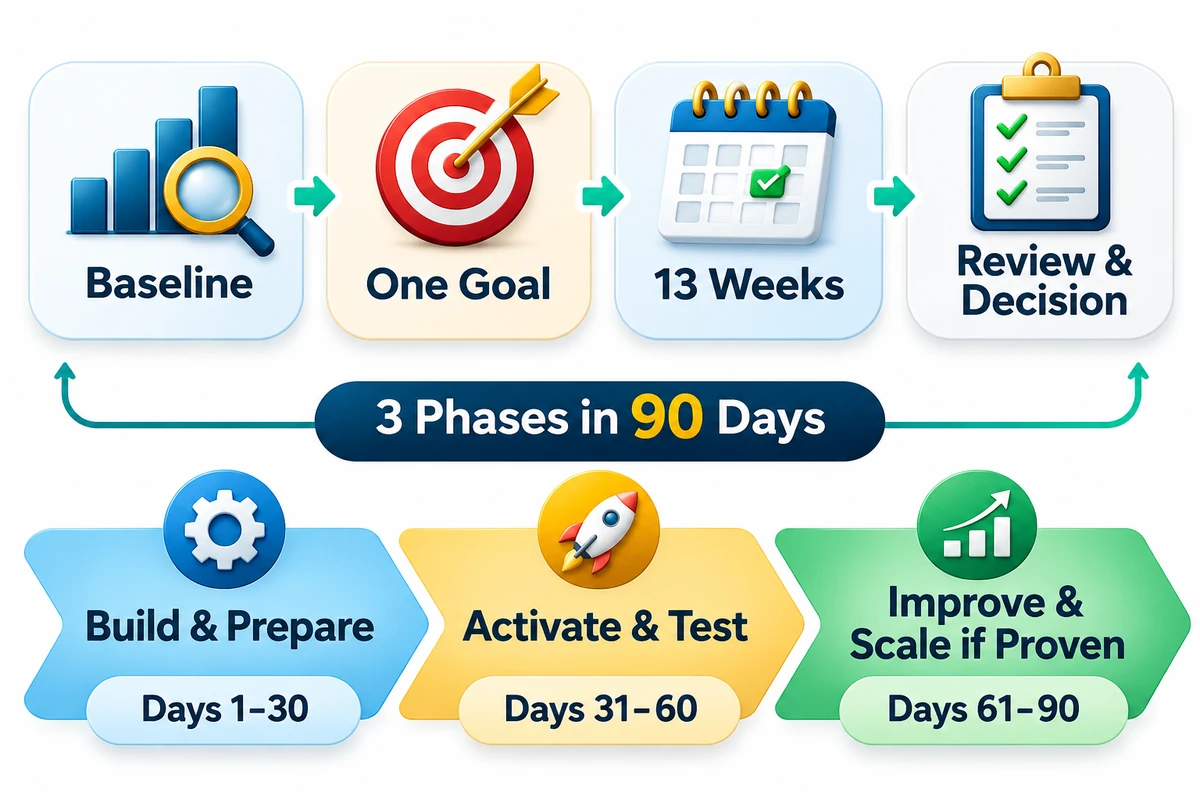
The Safe Growth Engineering method gives each month a different role.
Phase 1: Build and prepare — Days 1–30
Prepare the process, ownership, resources, materials, measurement method, and baseline. Run a limited test where appropriate. Useful outputs may be a working procedure, reliable data, an approved offer, or a resolved delivery constraint—not necessarily immediate sales.
Phase 2: Activate and test — Days 31–60
Run the initiative, observe customer and operating responses, and record evidence. Where A/B testing is suitable, change one variable at a time and document the hypothesis, audience, duration, result, and learning. An incomplete test is inconclusive, not a winner.
Phase 3: Improve and scale conditionally — Days 61–90
Keep what is demonstrably useful, revise what underperforms, and stop activity that cannot justify its resources. Expansion depends on capacity, cash availability, quality, and risk. Scaling may mean a repeatable procedure or a better schedule—or deciding not to expand yet.
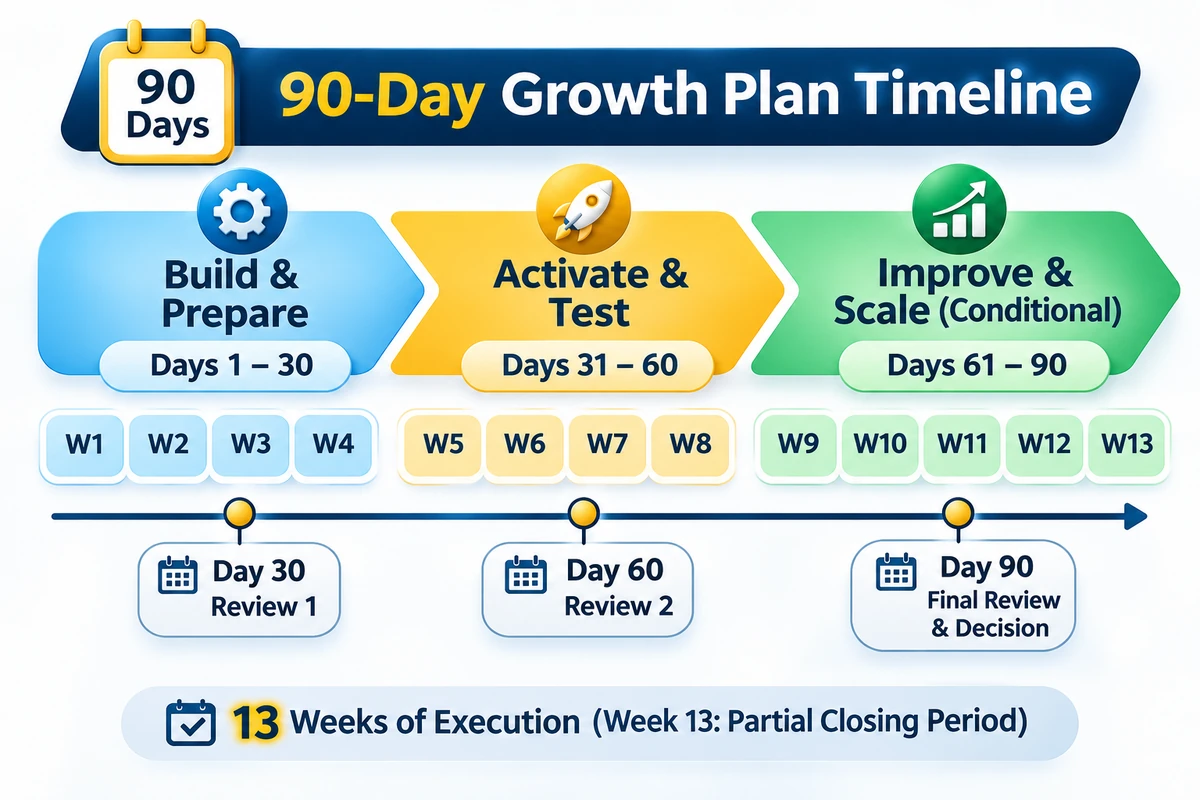
Turn the strategy into a 13-week action sequence
The weekly action plan makes the goal operational. Each week has one principal task with a named owner, calendar due date, and checkable output. This is an adaptable sequence drawn from the book’s 13-week structure, not a universal campaign checklist.
| Week | Main focus | Expected output |
|---|---|---|
| 1 | Review baseline and constraint | Baseline record |
| 2 | Prepare tools and resources | Readiness checklist |
| 3 | Run a limited test | Test record |
| 4 | Review and revise | Documented decision |
| 5 | Activate the initiative | Launch evidence |
| 6 | Review initial results | Progress report |
| 7 | Run a suitable experiment | Experiment record |
| 8 | Review phase two | Learning report |
| 9 | Apply lessons; stop ineffective work | Revised process |
| 10 | Expand only if constraints permit | Conditional expansion plan |
| 11 | Establish repeatability | Operating procedure |
| 12 | Compare against baseline | Results comparison |
| 13 | Close the cycle and plan next quarter | Review report |
A professional-services firm may need a process improvement rather than a marketing experiment. A workshop may need to validate delivery capacity before accepting more contracts. Do not write vague tasks such as “improve operations.” Specify an action, owner, date, and output. For example: “Review the booking workflow, identify the three most common delay causes, and submit a revised procedure by 12 March. Owner: business owner. Output: approved procedure with documented changes.” Record estimated hours, costs, resources, status, and notes when they help test feasibility.
Use checkpoints to prevent late surprises
Set three decision points. Day 30: review baseline quality, tools, responsibilities, and the initial test; resolve critical readiness issues before full activation. Day 60: compare actual execution with the plan, review customer response, cost, quality, and capacity, then decide what continues, changes, or stops. Day 90: compare evidence with the original baseline and target, and document results, causes, assumptions, and next-quarter decisions.
A checkpoint is a decision point, not a ceremonial report. Preserve the original target; document any material change so the closing assessment remains credible.
Build accountability into the operating rhythm
The method distinguishes three levels.
Daily accountability — personal commitment
Identify the one important action today that supports the 90-day goal. This protects attention without ignoring normal operations.
Weekly accountability — a review partner
Choose a partner, manager, or adviser who understands the business. Review what was completed and its evidence, what was delayed and why, the main obstacle, and the next task.
Monthly accountability — evidence-based review
At Days 30, 60, and 90, compare actual results with milestones and baseline. Record material differences and decisions. Accountability is not blame; it keeps commitments visible and problems actionable.
Use a pre-mortem to protect the plan
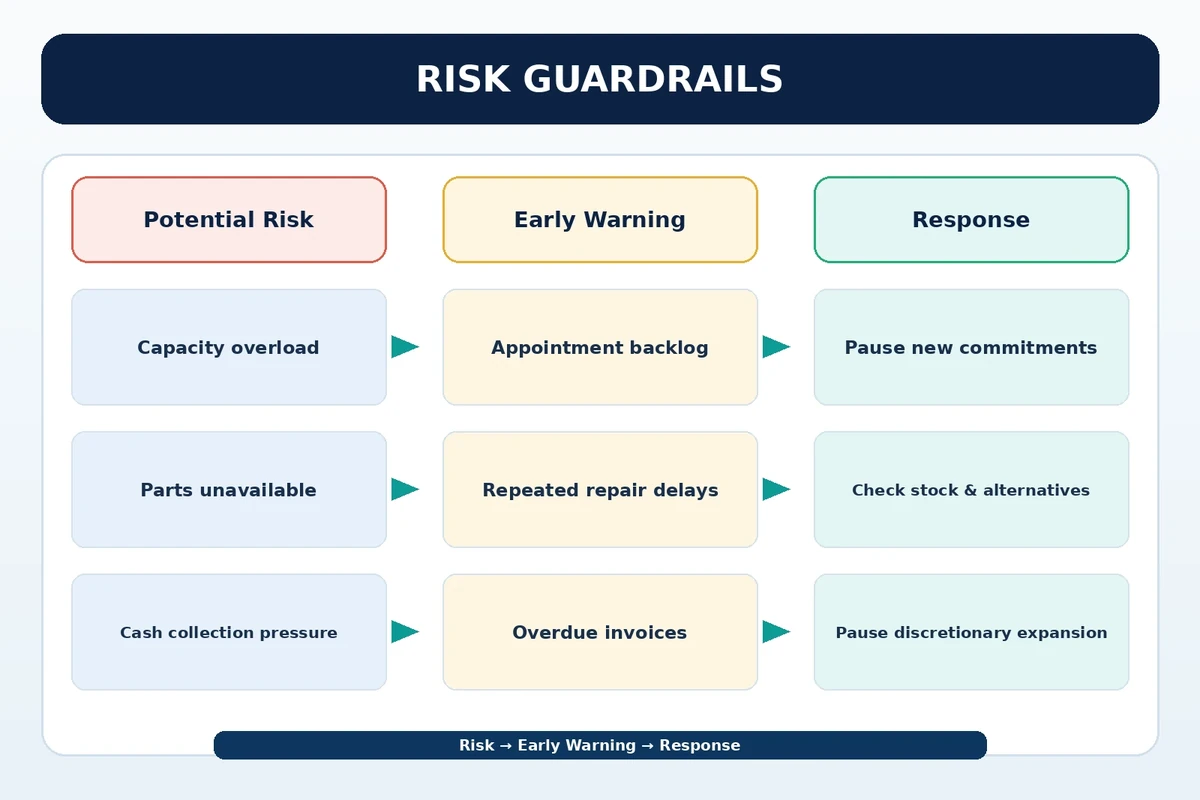
Imagine that the initiative has failed. Identify at least three plausible causes, their early warning signs, and a response or stop rule. This pre-mortem turns possible failure into observable controls.
| Potential failure | Early warning | Response or stop rule |
|---|---|---|
| Demand exceeds capacity | Appointment backlog or delays | Pause new commitments until capacity recovers |
| Critical parts unavailable | Repeated supplier-related delays | Review stock and alternatives before expansion |
| Cash collection lags spending | Overdue invoices and operating cash pressure | Review payment terms and pause discretionary expansion |
Assign an owner and define warning thresholds from the business’s own data. The British Business Bank’s cash-flow forecasting guide explains why cash receipts and payments should be recorded when they actually occur. A growing order book does not automatically provide the working capital needed to fulfil it.
Worked example: An independent mobile bicycle repair service in Bristol
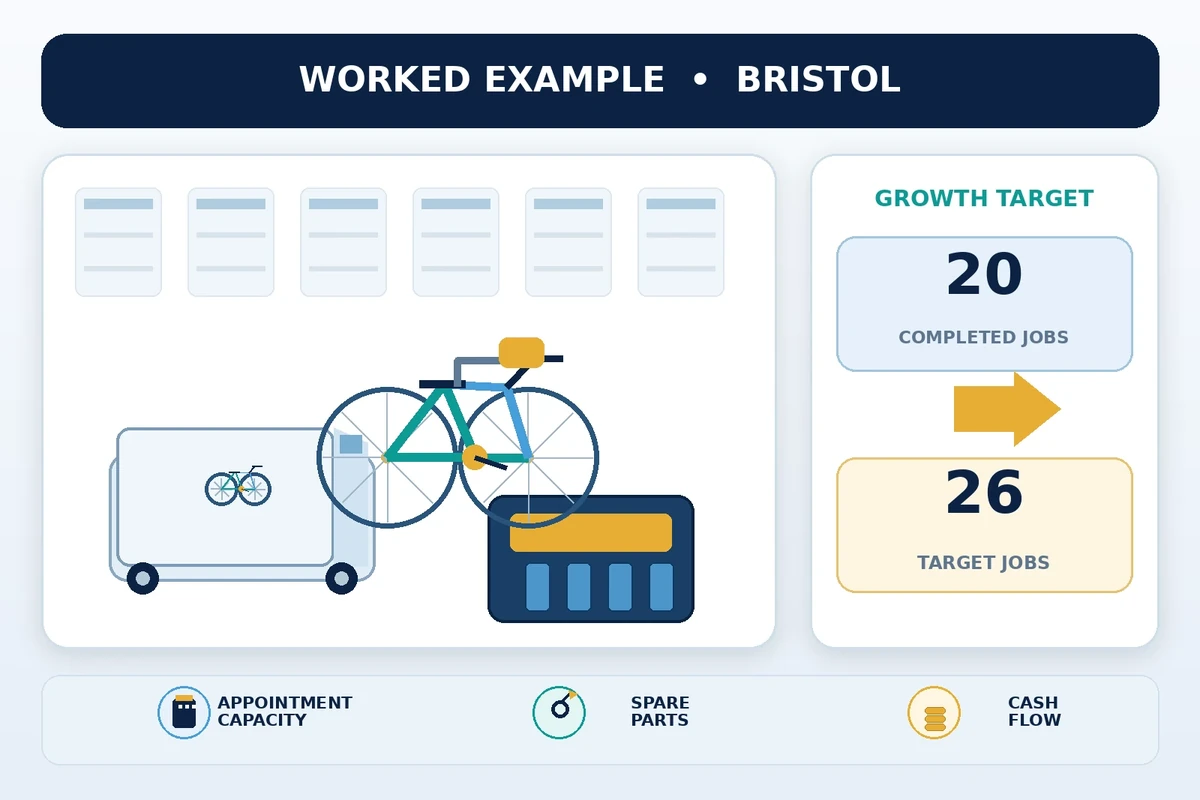
Consider a fictional independent mobile bicycle repair service operating in selected areas of Bristol. The owner repairs bicycles at customers’ homes or workplaces and manages bookings, parts, travel, and payments. The goal is to increase completed paid jobs without creating an unsustainable schedule. All figures and outcomes below are fictional and educational, not Bristol market benchmarks or forecasts.
Define the goal
Assume an illustrative baseline of 20 completed paid jobs in the latest 30-day period. The proposed target is 26 jobs in the final 30-day period, using a more reliable booking and scheduling process, fewer gaps between appointments, and better route organisation. The owner must first verify that six additional jobs can be delivered without reducing quality or exceeding acceptable working hours.
Build the execution sequence
The illustrative plan begins on 1 March 2027 and ends on 29 May 2027.
| Week / deadline | Main task | Owner | Output |
|---|---|---|---|
| 1 – 7 Mar | Review jobs, enquiries, cancellations and service time | Owner-mechanic | Baseline |
| 2 – 14 Mar | Map service areas, travel and weekly capacity | Owner-mechanic | Capacity assessment |
| 3 – 21 Mar | Standardise service and booking information | Owner-mechanic | Service menu |
| 4 – 28 Mar | Define booking windows and confirmations | Owner-mechanic | Booking procedure |
| 5 – 4 Apr | Activate revised booking process | Owner-mechanic | Live workflow |
| 6 – 11 Apr | Record bookings and cancellation reasons | Owner-mechanic | Performance log |
| 7 – 18 Apr | Test one suitable reminder variation | Owner-mechanic | Test record |
| 8 – 25 Apr | Review feedback and capacity | Owner-mechanic | Phase review |
| 9 – 2 May | Apply lessons and remove ineffective steps | Owner-mechanic | Revised workflow |
| 10 – 9 May | Extend availability if capacity permits | Owner-mechanic | Conditional plan |
| 11 – 16 May | Document repeat service and parts preparation | Owner-mechanic | Procedure |
| 12 – 23 May | Compare jobs, hours and delivery performance | Owner-mechanic | Results comparison |
| 13 – 29 May | Review the cycle and next-quarter decision | Owner-mechanic | Closing report |
The Day 30 checkpoint is 30 March, Day 60 is 29 April, and Day 90 is 29 May. Week 13 is a partial final period. The owner should not accept extra jobs simply to reach the target. If route planning or parts availability remains unreliable, process improvement may be the correct next step. The purpose is to show the link between a growth outcome and the operating system required to support it.
Build your plan with the 90-Day Growth Plan Builder
The Herotec 90-Day Growth Plan Builder translates the method into a structured working document. It is a focused MVP, not a full project-management platform.
Enter the business and growth stage, start date, one goal and its metric/unit/baseline/target/mechanism, the main constraint, available supporting indicators with periods and sources, Day 30/60/90 milestones, thirteen weekly tasks with owners/dates/outputs, time and budget limits, accountability arrangements, and three pre-mortem risks.
The builder produces a goal brief, three-phase plan, 13-week schedule, baseline snapshot, review records, risk barriers, and missing-information checklist. It supports browser print or PDF and CSV export of weekly tasks.
How the date calculation works
Day 1 is included: Day 90 = start date + 89 calendar days. Thirteen complete seven-day periods equal 91 days, so the final weekly review may be a partial period.
What the tool does not do
It does not guarantee growth, calculate a universal score, make an automatic scale decision, or calculate missing KPIs. It does not replace specialised tools for customer economics, marketing budgets, or risk assessment. It runs locally in the browser; optional local storage requires an explicit user action and can be cleared.
Build your plan with the interactive tool
Enter your goal, baseline, weekly tasks, checkpoints and risk barriers. The tool runs locally in your browser and does not send project data to an external server.
How to Read the Plan Numbers and Results
The summary lists your entries; it is not a performance report or forecast. Check each figure’s definition, unit, period, and source.
- Baseline and target: The baseline is the measured starting value; the target is your chosen end value. The gap is planned, not achieved.
- Actual and supporting metrics: Compare actual values only when metric definition, unit, period, and source match. The builder does not calculate missing KPIs.
- Day 30/60/90: Record outcomes and next actions at each checkpoint. These are review dates, not guaranteed result dates.
- Validation and warnings: “Validation complete” means required fields passed input checks, not that the plan is viable. Resolve warnings about missing risks and incomplete metric data.
- Decision log: Choose continue, adjust, stop, or scale, then record the reason, evidence, date, and owner. Scaling is never automatic.
In Bristol, moving from 20 jobs to a target of 26 is a gap of six jobs, not six achieved jobs or a market benchmark.
Reading rule: Decide from comparable actual data and the business’s capacity, cash, quality, and risk—not from the target alone.
Common mistakes that weaken a quarterly plan
Too many goals: select one principal outcome. Confusing activity with progress: more calls or posts do not necessarily improve the target. No named owner: shared responsibility can hide delays. Rigidly planning month three: use evidence from the first two phases. Scaling before checking capacity: more customers can increase workload, parts needs, and cash commitments. Changing targets without a record: preserve the original baseline and explain material changes. Skipping the close-out: use documented learning to shape the next quarter.
Frequently asked questions
Should a 90-day plan contain one goal or several?
One principal goal, supported by thirteen weekly tasks.
Do I need all six growth indicators?
No. Use relevant indicators with reliable data and record what is missing.
What if the business misses Day 30?
Identify the cause and impact, then document whether to continue, adjust, or delay.
Should I increase marketing expenditure in month three?
Only when evidence, capacity, and cash support it. Expansion is optional.
Is this the same as a business plan?
No. A business plan covers the wider business; this plan organises execution of one outcome within a quarter. See the UK government’s business-plan guidance.
What happens after week thirteen?
Close the cycle, preserve the baseline comparison, document learning, and set the next-quarter priority.
Make the next 90 days an execution cycle
A growth objective becomes useful when it changes what the business does, who is responsible, and how progress is reviewed. Start with a genuine baseline, select one measurable outcome, organise the work into three phases and thirteen weekly commitments, and establish risk barriers before additional demand pressures operations.
The cycle does not have to end with every target achieved. It should end with a clear account of what happened, why it happened, what was learned, and what decision follows.
Get the Book: Safe Growth Engineering
Keep the plan you build here as a free working resource: print the summary or save it as a PDF, and export the weekly task list as CSV. A separate worksheet is not added because the builder already provides the core outputs needed to retain and review the plan.
For the broader method behind this 90-day framework, explore Safe Growth Engineering by Mohamed Fathy. The book expands on the principles of building growth that is measurable, operationally sustainable, and controlled by clear risk boundaries.
References
- Fathy, Mohamed. Safe Growth Engineering. Chapter 10, and Chapters 1, 8, and 9.
- Herotec. Functional Specifications – Risk, Growth & Decision Tools. Section 4.6.
- British Business Bank. How to Create a Cash Flow Forecast in 4 Steps (accessed 21 November 2026).
- UK Government. Write a Business Plan (accessed 21 November 2026).
The Bristol business and its example data are fictional and educational.