
A small business can be busy on social media and still be unclear about whom it is trying to reach, what problem it is solving, or why a prospect should choose it. Activity is not the same as direction.
The practical question is not “What should we post next week?” It is “What customer progress are we trying to help create, what evidence supports that choice, and what is the smallest repeatable system we can operate?” This guide uses a different example from the Arabic edition: a hypothetical bookkeeping service for independent consultants and small creative studios.
A Small Business Marketing Plan should connect evidence to action, not begin with a platform list. A Marketing Plan for a Small Business becomes executable when every activity has an objective, an owner, a test and a way to measure what happened.
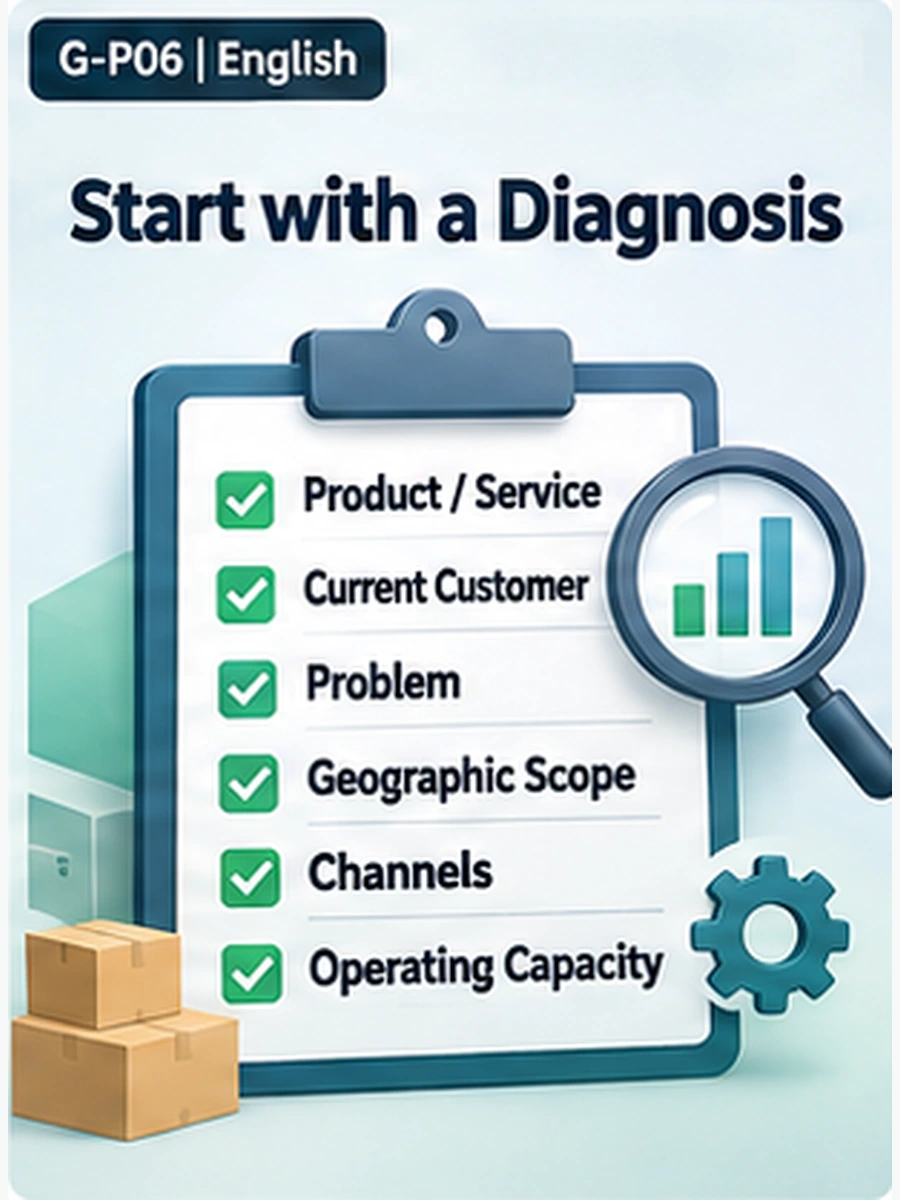
1. Establish the business baseline before choosing tactics
Start with the offer. Describe what the business delivers, who currently buys, how the service is fulfilled, and what makes delivery succeed or fail. A bookkeeping firm may offer monthly reconciliations, management reports, or catch-up work.
Build the baseline from records the business already owns: enquiries, proposals, closed and lost opportunities, recurring service questions, customer feedback, delivery time, capacity, and the source of referrals. Separate recorded observations from interpretations.
Write down the constraints that shape the plan: number of client projects the team can serve, time available for marketing, response ownership, service geography or remote delivery boundaries, available proof, and a budget ceiling already reviewed by the business. If a fact is unavailable, list it as missing.
Project stage matters. A new service may need to verify a narrow problem and the willingness to pay for a defined outcome. A service with several active customers may need to improve qualification and onboarding.
2. Define the buyer through evidence, not demographics alone
A target market is a group the business can identify and reach, not a vague category such as “all small businesses.” Useful distinctions may include the work a buyer does, the complexity of their records, the event that triggers a search, their risk tolerance, or the way they select a provider.
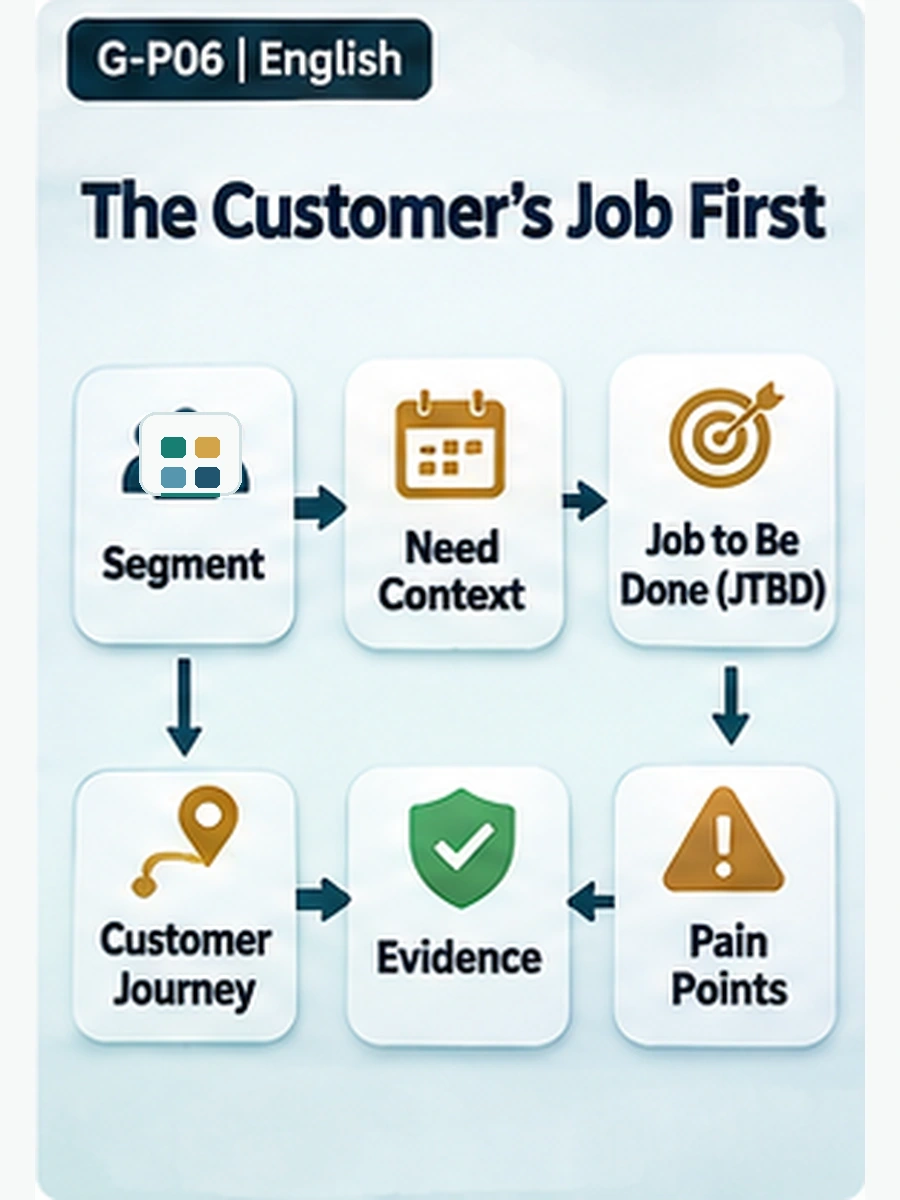
A Customer Persona is a working model that organizes relevant evidence about a buyer’s context, goals, concerns, decision process, trusted information sources, and constraints. It should be built from customer conversations, sales records, reviews, and observed behavior.
For the hypothetical bookkeeping service, one possible segment might be independent consultants who handle their own invoices but struggle to turn transaction records into a monthly view of cash and project profitability. That description remains a hypothesis until the business checks it with interviews and enquiry data.
Jobs to Be Done (JTBD) helps move the conversation beyond job title or software preference. It asks what progress the buyer is trying to make in a particular circumstance.
Ask about a recent event rather than asking people to imagine what they might do. “Tell me about the last time you needed a clearer view of your business finances.
Pain points can be functional, financial, social, or emotional.
A Target Market for Small Business should be defined by a meaningful need and reachable behaviour, while a Customer Persona remains a testable model rather than a fictional fact.
For the JTBD definition and its functional, social, and emotional dimensions, see the Christensen Institute overview.
3. Map the buying journey and the proof required at each stage
The customer journey is not merely a funnel diagram. It is a way to understand what a buyer needs at different moments. During awareness, the person may be trying to name a problem. During exploration, they compare possible approaches.
For a bookkeeping prospect, an awareness-stage resource might explain the difference between recording transactions and understanding project profitability. An exploration-stage resource might show the information needed for a first review.
Match the message to the evidence. A statement such as “trusted by hundreds of businesses” requires a real, supportable basis. Without it, use verifiable explanations of the process, anonymized examples with permission, team qualifications that can be substantiated, or a clear service boundary.
A useful general distinction is to combine secondary sources with direct customer research; see the SBA market-research guidance, noting that it is a U.S. reference rather than Egypt-specific guidance.
4. Analyse alternatives and convert findings into a positioning choice
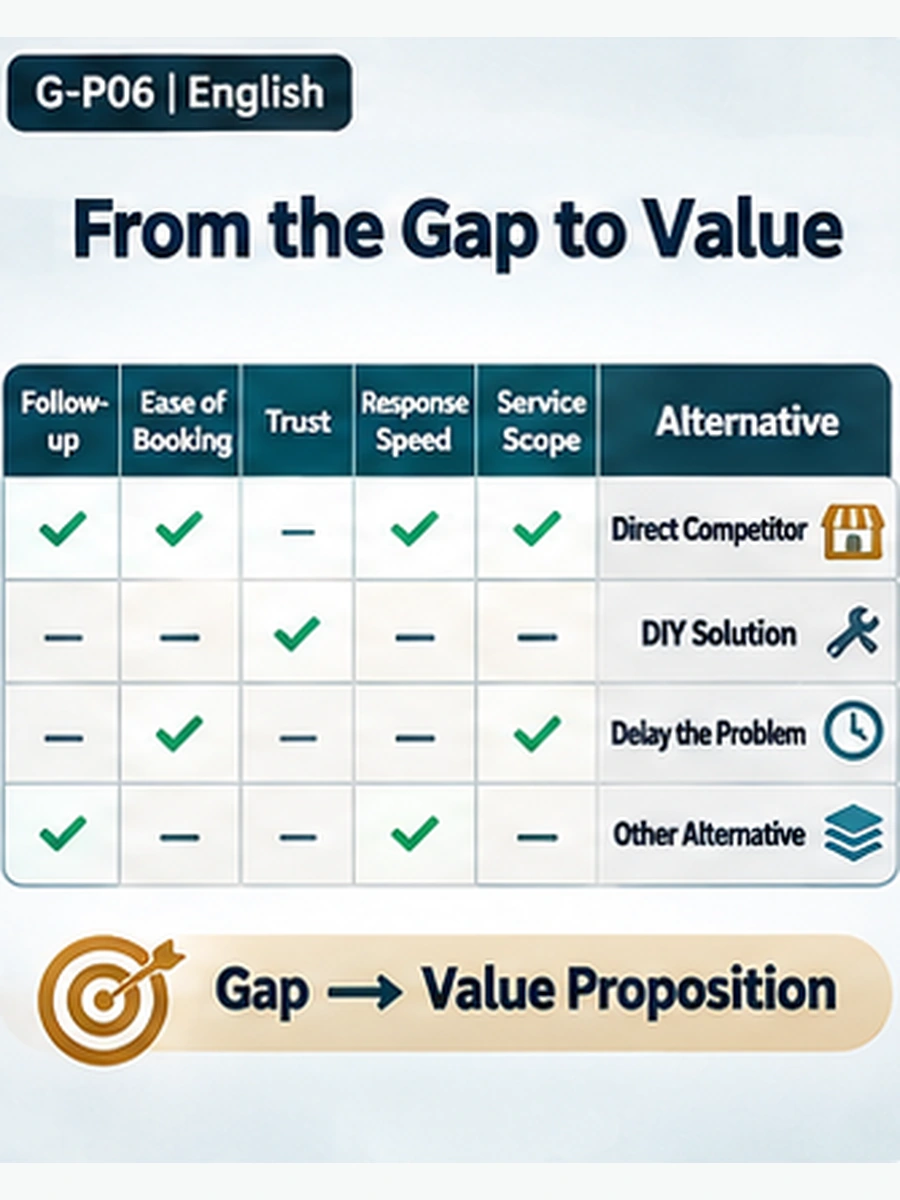
Competitor analysis should include more than businesses with the same label. Buyers may compare direct service providers, software, a part-time employee, an accountant they already know, or the option of postponing the work.
Use an enhanced SWOT as a decision aid, not a decorative four-box exercise.
Positioning brings the choices together.
5. Select a growth engine that fits the offer and operating capacity
The Safe Growth Engineering book presents growth as a repeatable mechanism rather than a collection of disconnected marketing activities. Its fifth chapter asks the business to choose a growth engine that fits its model, resources, and audience.
A specialist bookkeeping service may learn through educational content that answers recurring financial-management questions, professional referrals, or focused partnerships with business advisers. A product-led business may rely on a different engine.
A secondary channel is justified only when it has a clear role. For example, a referral relationship may introduce a prospect, while a short explanatory page helps that prospect understand the service before a conversation. The two channels support one journey.
A Small Business Marketing Strategy should reflect the firm’s operating model, customer evidence and ability to deliver—not the popularity of a platform.
6. Build the channel-message-evidence match
Choose a channel because of buyer behavior and the task the message must perform.
For the hypothetical bookkeeping service, an educational article may help a consultant recognize a gap in project reporting. A referral partner may provide trust at the moment the buyer needs help.
Every channel needs a role, a message, a format, an owner, a cadence, and a next action. “LinkedIn” is not a plan.
7. Turn campaign activity into a marketing operating system
A campaign ends; an operating system can keep working. The seventh chapter of the book describes a smart marketing system through connected components: useful content, social channels, email, WhatsApp Business, search visibility, paid advertising, and the appropriate use of AI to support work.
Give each recurring task an owner and a standard. Examples include responding to qualified enquiries, updating a service page when the scope changes, requesting feedback after delivery with permission, reviewing search questions, and checking whether published content still reflects the service.
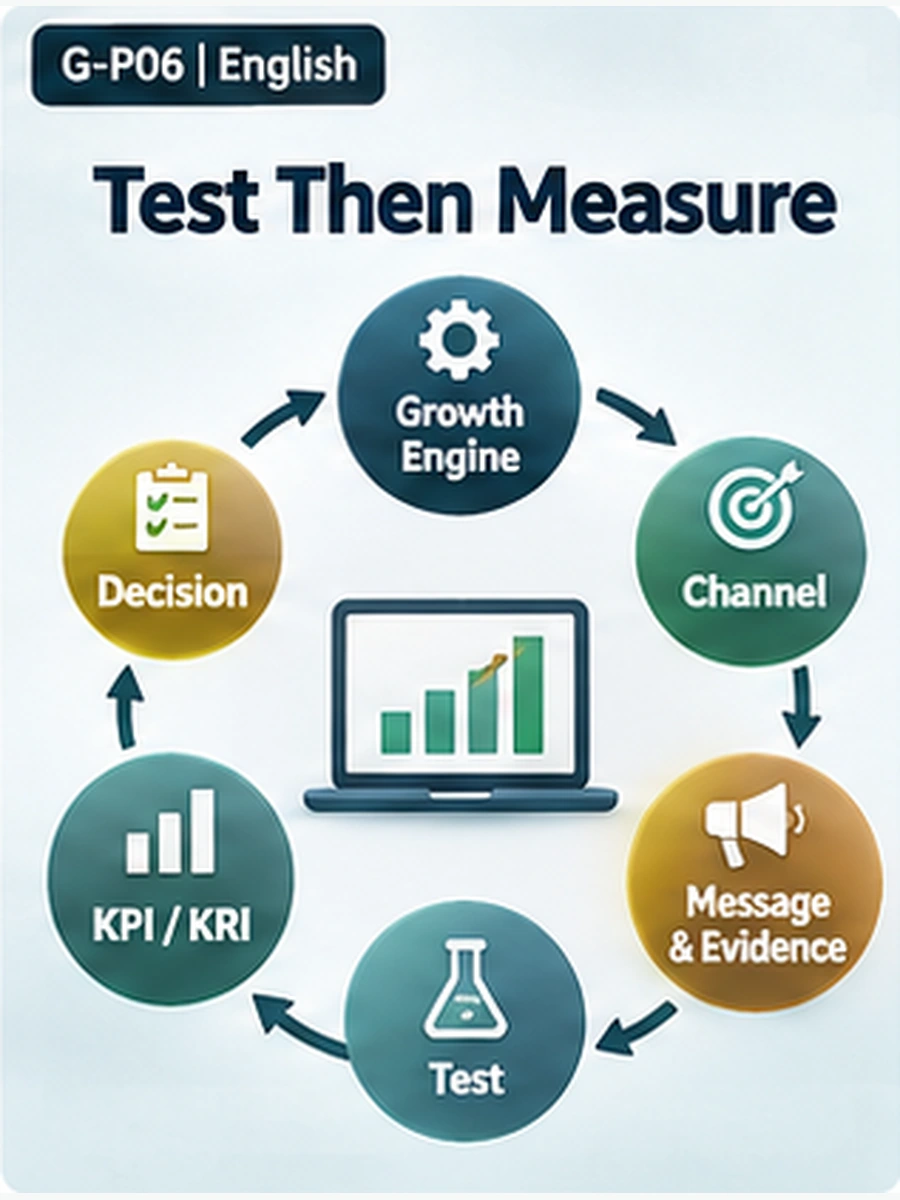
Define a small set of tests. Each test should state the hypothesis, the audience, the message or change, the channel, the time window, the budget boundary, the measurement, and the decision rule. Change one major variable at a time where practical.
8. Budget and operational guardrails
The plan should not create a budget independently of the business’s financial and operational limits. G-P05 addresses the safe marketing ceiling using project stage, loss capacity, and deployable cash after reserve.
List the proposed spending by purpose: content production, a landing page, customer research, a channel test, or a referral activity. State the amount, period, owner, and expected learning or output.
Capacity is another guardrail. A marketing activity can succeed at generating enquiries and still damage the customer experience if the business cannot respond, onboard, or deliver. Before scaling, check available hours, service capacity, response ownership, quality control, concentration risks, and the ability to handle complaints.
9. Set measures that lead to decisions
Select a primary objective and a small number of supporting measures. For a consultant service, the objective may be to increase qualified discovery conversations, not merely website sessions.
Chapter eight distinguishes vanity metrics from action metrics. Followers, likes, and views may describe attention, but they do not prove that the business acquired a suitable customer or earned a profit.
For each KPI or KRI record its definition, unit, data source, baseline, target, owner, and review date. If a baseline is unavailable, mark it “to be established” rather than inventing a target. Keep the same counting rules across periods.
A measure matters when it triggers a decision. If qualified enquiries rise but the team cannot respond in time, the next step may be operational rather than more advertising. If enquiries are high but few fit the service, revise the segment or message.
Choose Marketing KPIs that connect directly to the objective and the decision the team will make next.
Choose measures that connect to an objective and journey stage rather than tracking every available number; see Shopify’s marketing KPI guide for examples.
| Objective | Possible primary KPI | Possible guardrail KRI |
|---|---|---|
| Increase qualified enquiries | Enquiries meeting the agreed qualification definition | Response time and unserved requests |
| Improve progression to proposal | Share of qualified conversations that receive a proposal | Drop-offs and unresolved objections |
| Improve repeat or referral activity | Returning customers or qualified referrals | Delivery capacity and service quality |
10. Worked example: a small bookkeeping service
Consider a fictional bookkeeping service for independent consultants and small creative studios. The founder has a basic service description but little structured marketing data. This example is educational and hypothetical; it does not report survey results, market size, competitor rankings, or real conversion rates.
The first action is to review previous enquiries and proposals, then speak with a small number of current or former customers, with consent.
The plan chooses one initial segment for the test rather than declaring that all consultants are the target. It drafts a value proposition focused on a monthly reporting conversation and a defined set of deliverables.
The operating plan identifies the content owner, the person who responds to enquiries, the discovery-call process, and the review date. The budget is limited to an amount already approved by the business; if the safe ceiling is not documented, the plan records that approval is outstanding.
At the end of the test window, the founder reviews the evidence. If the people who enquire do not match the selected segment, revise the segment or message. If the enquiries fit but proposals are not accepted, investigate fit, scope, trust, and pricing rather than immediately increasing traffic.
Marketing Plan Generator
Turn your business inputs into an editable plan draft, while flagging assumptions and missing evidence before decisions are approved.
HEROTEC • G-P06
Marketing Plan Generator
Turn your business inputs into an editable plan draft, while flagging assumptions and missing evidence before decisions are approved.
11. Use the Marketing Plan Generator
The Marketing Plan Generator organizes the information you supply into an editable draft. Start with the business, product or service, stage, and one primary objective. Add a customer segment, the evidence you have, the job the customer is trying to complete, competitor observations, and the value proposition.
Next, record the channels you selected and why, the messages, the budget limit and currency, any safe ceiling already checked through G-P05, the available marketing hours, the timeline, and the responsible owner. Add KPIs and KRIs with a baseline, target, source, and review date where available.
Version one is rule-based and runs in the visitor’s browser. It does not call an AI API, search for competitors, invent market data, or produce a fictional customer as fact. It supplies structure and prompts; the business remains responsible for validating its inputs and approving its decisions.
12. Common planning mistakes and FAQs
Common mistakes include selecting channels before defining the buyer, treating an imagined Persona as research, copying a competitor’s campaign without knowing its context, spreading effort across too many platforms, setting targets without a baseline, and measuring attention without deciding what it means.
**Does every small business need a long marketing document?** No. The plan should be as detailed as the decisions require. A one-page plan can be useful when it includes the objective, buyer, evidence, offer, channels, owner, constraints, measures, and review date.
**Should I define a Persona before doing customer research?** You may write a provisional hypothesis to guide questions, but label it clearly. Validate it with conversations, sales evidence, reviews, and observed behavior before treating it as a customer fact.
**How many channels should I use?** There is no universal number. Select the channels that match the buyer’s behavior and that the team can operate and measure consistently. Add another channel only when it has a clear role and sufficient capacity.
**When should I revise the plan?** Review operating activity frequently enough to respond to problems, and review strategic assumptions when new customer or performance evidence appears. Keep definitions and measurement windows consistent so that a change in the numbers means something.
Conclusion: make the plan learnable
A useful Small Business Marketing Plan makes the next decision clearer. It starts with the customer’s circumstances, chooses a credible position, selects a growth mechanism the team can sustain, and links messages and channels to measurable actions. It protects the business from unsupported promises and unexamined spending.
Connect better planning with a more disciplined growth system.
Explore Safe Growth EngineeringReferences and Methodology
- Herotec, Safe Growth Engineering, Chapters 3 (customer understanding), 4 (market and competitor analysis), 5 (growth engine), 6 (safe growth constraints), 7 (marketing operating system), and 8 (measurement).
- Christensen Institute — Jobs to Be Done Theory, for customer jobs and decision circumstances.
- Shopify — How To Create a Small Business Marketing Plan in 7 Steps, as a comparison source for small-business planning structure.
- U.S. Small Business Administration — Plan Your Business, for general market-research and competitor-analysis methods; no U.S.-specific regulatory assumptions are applied.
- Shopify — Marketing KPIs to Track Your Performance, for examples of performance measures.
Online sources reviewed: 21 November 2026. Article examples are fictional, not verified market data or performance results.
The generator creates an organizing draft only; validate the evidence and constraints, then approve the plan internally before execution.