
A small business owner sees a nearby provider advertising a lower price and immediately considers matching it. Another owner notices a competitor posting every day and decides to increase social activity. Both reactions may be premature. They respond to visible competitor activity without first asking what customers are comparing, what evidence supports the observation, or whether the proposed response fits the business.
Competitor Analysis for Small Business is not a directory of rival names or a race to copy offers. It is a disciplined way to understand the alternatives customers consider, record what is known about those alternatives, identify needs that remain poorly served, and test a response the business can deliver. The objective is not to prove that a competitor is weak. It is to make a better decision about your own offer.
This guide moves from competitor mapping to evidence logging, five-dimension comparison, gap discovery and an actionable opportunity. It also explains how to treat customer reviews as useful but limited evidence, distinguish facts from interpretations and hypotheses, and use the Competitor Intelligence Matrix to keep observations traceable.
1. Define the decision before collecting data
Before opening a comparison sheet, define the decision: change the offer, improve service, reach a segment or prepare for a potential entrant. The decision tells you which information matters.
Ask which options customers consider, what each delivers, what customers praise or question, and which need your business could serve with a realistic capability. This keeps research connected to customer value.
Chapter 4 of <em>Safe Growth</em> uses three connected lenses: enhanced SWOT tied to decisions, competitor analysis and gap analysis for unmet needs. The sequence moves from observation to interpretation to an opportunity worth testing.
Do not analyse every business in depth. Map all three competitor types, then focus on the options most relevant to the decision. The book recommends a limited deep-dive group of up to four important competitors.
2. Map competitors and alternatives
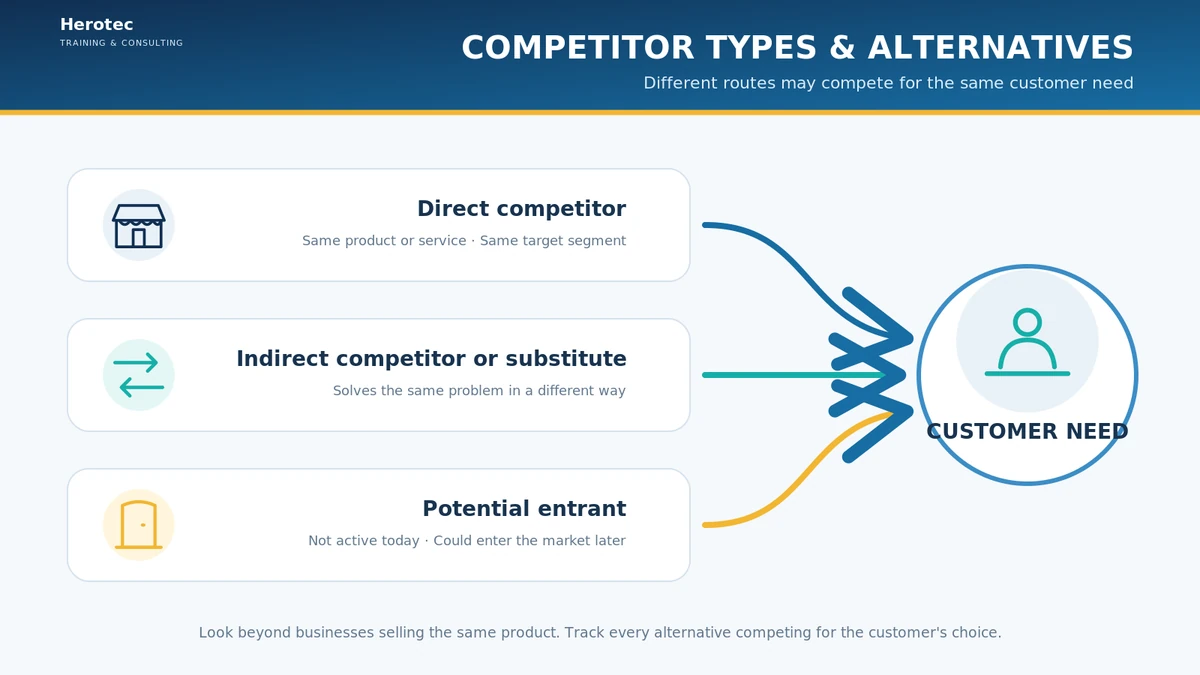
Customers compare ways to solve a problem, not only businesses with matching category labels. The book distinguishes three types.
Direct competitors
A direct competitor offers a similar product or service to the same segment. For a custom-furniture studio, another local maker serving the same apartment buyers may be direct. Compare scope, lead time, materials, delivery and installation.
Indirect competitors or substitutes
An indirect competitor or substitute solves the same problem differently. A buyer needing a desk may choose ready-made furniture, a second-hand item or a DIY option. These alternatives compete for the same budget and outcome.
Potential competitors
A potential competitor may enter later, such as a large retailer that could add customisation. Record why the possibility matters and what signal would prompt review; do not describe entry as certain.
Map the wider field, then select the most relevant options. Keep each type visible because direct providers and substitutes do not always need identical comparisons.
3. Create an evidence log before comparing
Build a retrievable log: competitor, dimension, specific observation, evidence class, source description and observation date. Add a direct URL for a public page, advertisement, listing or review.
Use four classes: observed fact tied to a source; customer voice from a review, interview or sales record; interpretation drawn from evidence; and hypothesis that still needs testing. Never present an interpretation or hypothesis as a fact.
- Observed fact: A statement that can be tied to a source, such as a service page listing a defined scope or a published price including delivery.
- Customer voice: A public review, interview note or sales-record pattern. Preserve the substance, not a reviewer’s name, phone number or other identifying detail.
- Interpretation: A conclusion drawn from one or more observations. For example, unclear warranty terms may increase buyer hesitation. Label it as an interpretation, not as wording from the source.
- Hypothesis: A proposition that still needs testing, such as the possibility that apartment residents value a confirmed installation window more than a lower headline price. Do not present it as a proven customer fact.
Prices, offers and reviews change. Preserve the date and recheck consequential claims before a decision. If a page is no longer accessible, mark its current status unverified instead of calling the old observation current.
Use information your business is entitled to use. The matrix is manual and does not crawl websites. Reviews are signals, not necessarily a representative sample; seek recurring patterns across independent sources and do not generalise from one comment.
Google Business Profile guidance calls for genuine reviews and disallows incentives conditioned on positive reviews or removal of negative ones. This is platform guidance, not Egyptian law. Do not expose reviewers’ private information.
4. Compare five dimensions
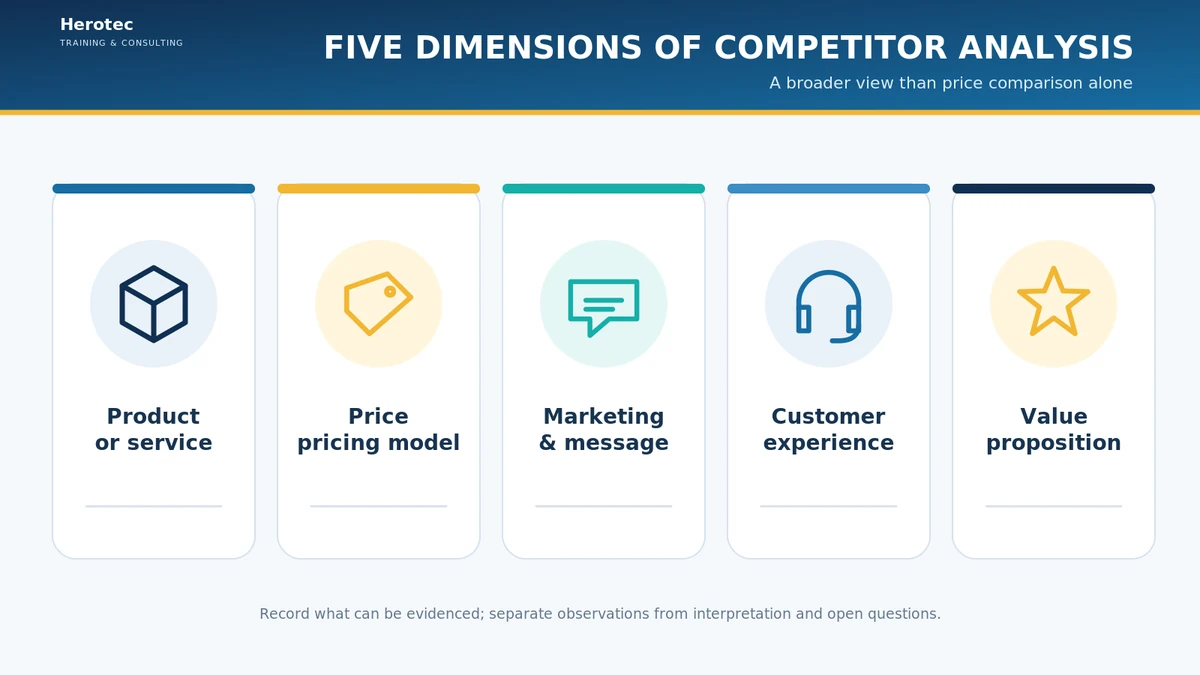
Chapter 4 recommends five dimensions to avoid reducing the analysis to price. Apply them consistently and record unknowns rather than guessing.
Dimension 1: Product or service
Product or service: what does the customer receive? Record scope, observable quality signals and exclusions. For a service, clarify whether inspection, installation or parts are included.
Dimension 2: Price and pricing model
Price and pricing model: record price, currency, unit, date and inclusions. Compare delivery, visit fees, warranty and extras. A public selling price does not reveal a competitor’s cost or margin.
Dimension 3: Marketing, message and channels
Marketing and message: how does the business explain value, whom does it address, and which promises or channels recur? Record the message and supporting proof, not just the platform name.
Dimension 4: Customer experience and reviews
Customer experience: look for patterns in booking, response, delivery and support. State the sample limits; a small set of comments is not a verdict on all customers.
Dimension 5: Value proposition and claimed differentiation
Value proposition: what unique benefit is claimed, and what evidence supports it in the customer experience? If a “fast installation” promise cannot be verified, say evidence is not visible rather than alleging deception.
5. Turn SWOT into decisions
Four SWOT lists are not a decision. Ask what evidence shows a strength matters to customers, which weakness can be fixed now, what signal supports an opportunity, and what early indicator would reveal a threat.
For every item record the observation, evidence, interpretation, decision, owner and review date. Label weakly supported items as hypotheses and connect the SWOT to an action plan.
An opportunity is more specific than a general wish for online growth. A threat is more than a large competitor’s name; it is a change that could affect your ability to attract or serve customers.
6. Find the four types of gap
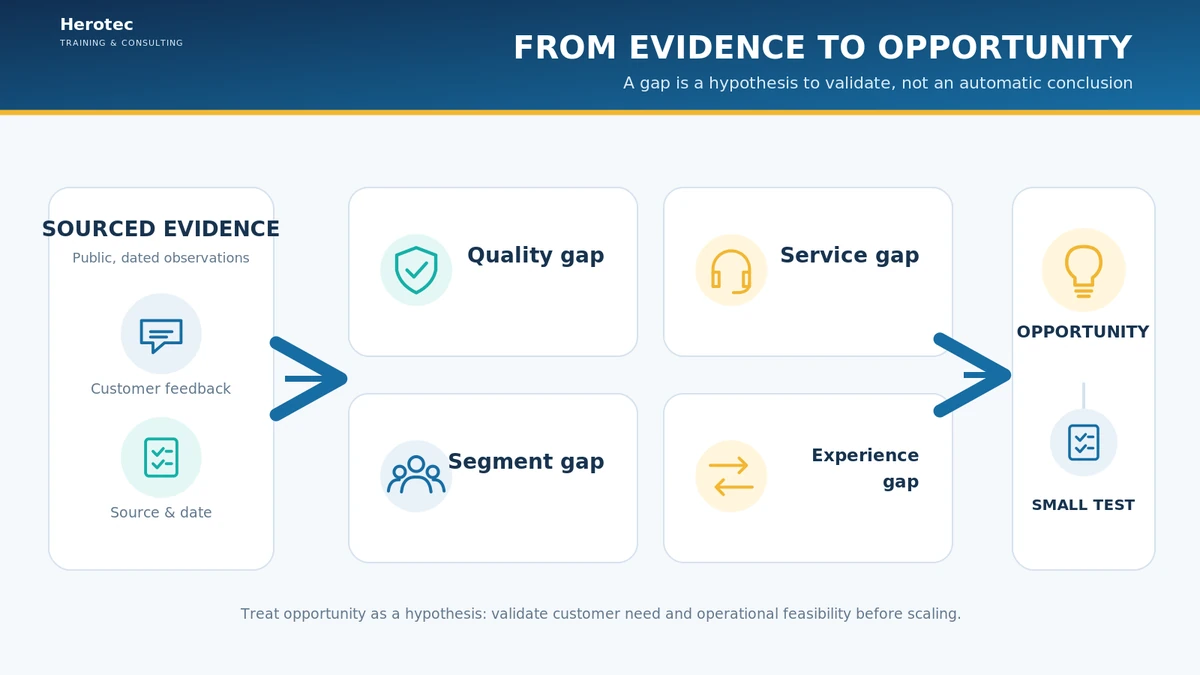
A gap is a need not adequately served by the alternatives reviewed. It is a possible opportunity within the evidence collected, not proof that the whole market is empty.
Quality gap
Quality gap: low-cost options may not meet quality expectations while premium offers exceed the target budget. Check what quality means to buyers and whether you can deliver it consistently.
Service gap
Service gap: delivery, fitting, repair, support or warranty may be weak. A promise cannot close this gap without process, capacity and a measurable standard.
Segment gap
Segment gap: providers may overlook a group with a related need but different timing, location or buying process. Validate demand through conversations, records or a small test; do not invent a Persona.
Experience gap
Experience gap: a buying or service journey may be confusing, slow or opaque. Clear steps, scope and appointment updates can matter if the business can fulfil them.
Before acting, test whether the need is real, whether your response is meaningfully better, and whether resources and operating capacity can support it. This links the analysis to Chapter 5’s growth-engine choices.
7. Build an Opportunity Canvas
Bring the conclusion into one Opportunity Canvas. The book specifies your position against the three most relevant competitors across five dimensions, actual strengths, the gap, the opportunity to pursue and the threat to prepare for.
Add execution fields: evidence, proposed response, capability and cost check, next test, owner, date and success signal. These are practical planning fields, not a universal scoring model.
Do not use one score to declare a business “better.” Any internal ranking needs defined criteria, weights, purpose and source, with missing evidence visible. This tool does not generate an automatic ranking.
8. Hypothetical example: a small custom-furniture studio
This is a hypothetical teaching example, not real market research. Imagine a small custom-furniture workshop deciding whether to compete on headline price or make the buying and installation process clearer.
The map includes another local maker as a direct competitor, ready-made or second-hand furniture as substitutes, and a large retailer that may add custom work as a potential entrant. They serve the same need in different ways.
The owner records public offer details and non-identifying customer comments, plus notes from conversations. In this hypothetical sample, buyers ask whether assembly is included, when delivery will happen and whether the product will fit a small room. Every note has a source and date.
The five-dimension review does not establish rivals’ manufacturing quality or cost base. It does suggest that some offers reviewed leave assembly scope or delivery timing unclear. The owner marks this as an experience-gap hypothesis, not a claim that competitors fail to explain their terms.
The proposed response is a written brief covering measurements, materials, included assembly, a delivery window and change approval. Before marketing it, the workshop checks production and installation capacity. A limited test asks whether the clearer brief reduces repeated scope questions and improves qualified enquiries.
The test evaluates one offer for one defined group and period. It does not prove the studio is better than every alternative. The evidence must be updated before expansion.
9. Use the Competitor Intelligence Matrix
The matrix records the product, segment and decision, then allows up to four competitors for a focused review. Add observations across the five dimensions, with an evidence class, source description and date.
Add a URL for public sources, or a non-identifying reference for interviews and internal records. Then record the gap, customer need, evidence, response, capability check, test, owner, date and success signal. Threats can be logged with a review trigger.
The summary shows completed and missing dimensions and reports insufficient comparison data when evidence is incomplete. Filled fields do not prove claims or market representativeness. The tool does not crawl sites, fetch reviews or invent prices and market shares.
Data stays in the browser. Local saving happens only when selected; CSV exports the tables and Print / Save PDF uses the browser. Clear removes the data and local draft. Do not enter personal or confidential information.
10. Move from analysis to a small test
Do not change everything after reading the matrix. Select one evidence-backed gap and design a bounded test: clarify pricing, warranty, delivery, booking or one segment-specific offer. Assign an owner, date and observable outcome.
Before approval, check the three competitor types, five dimensions, sources and dates, review sample limits, decision-linked SWOT, evidence for the gap, delivery capability and a defined test.
- Does the map include direct competitors, substitutes and a potential entrant, with each type labelled?
- Have the most relevant options been compared across all five dimensions rather than price alone?
- Does every observation have a source, date and evidence classification?
- Have reviews been treated as limited signals rather than a representative market sample by default?
- Are SWOT points linked to decisions, and is the proposed gap supported by evidence?
- Can the business deliver the response within its cost, capacity, quality and timing constraints?
- Is there a test, owner, success signal and review date before any expansion?
Review when information or a decision changes, not after every competitor post. Sustainable differentiation comes from understanding customers and delivering value consistently.
11. Frequently asked questions
How many competitors should a small business analyse?
Map all three types, then focus on up to four important options for deeper analysis. Useful evidence matters more than a long list.
Should price be part of the comparison?
Yes, but price is one dimension. Compare inclusions, warranty, service, delivery, extras and date. Do not infer cost or margin from a public price.
Are customer reviews enough to identify a gap?
No. Reviews are limited customer voice. Look for patterns across sources, compare them with interviews and your own records, then test the need.
Can the matrix automatically identify the best competitor?
No overall score or automatic winner is generated. The tool organises evidence and exposes gaps. A manual ranking needs transparent, purpose-specific criteria and weights.
What should I do when I cannot find a source?
Do not guess. Record a question or hypothesis, or leave the dimension incomplete and report insufficient comparison data.
Make competitor insight part of a safer growth system
Competitive decisions should not be driven by price watching alone. Understanding customer needs, alternatives and gaps helps you choose an offer and an operating response that fit your resources and constraints. Use the matrix to record what you know, then test one opportunity before scaling it.
Explore the Safe Growth toolkit to connect market understanding and marketing decisions with growth and risk management.
References
- Mohamed Fathy, Safe Growth: A Practical Method for Building a System That Grows with Confidence and Resists Risk, first edition, 2026; Chapter 3, “Understand Your Customer Before Marketing”; Chapter 4, “Analyse the Market and Competitors Intelligently”; Chapter 5, “Design the Growth Engine That Fits Your Business,” especially Chapter 4, pp. 29–34.
- U.S. Small Business Administration, Plan your business: Market research and competitive analysis. A general U.S. methodology reference, not Egyptian regulation or a local standard.
- Google Business Profile Help, Tips to get more reviews; platform guidance on genuine customer reviews and incentives.
- Google Business Profile Help, Manage customer reviews; platform guidance for handling customer reviews.
Online sources accessed 21 November 2026. Search results were reviewed as an exploratory SERP spot-check to understand intent and editorial gaps; this was not a full audit of the top ten results and does not establish search volume or keyword difficulty.